
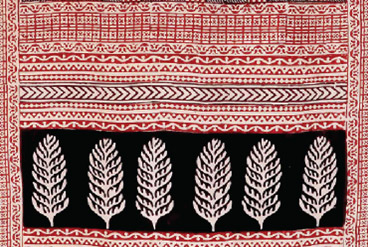
The craft and the village derive their names from the river ‘Baghini’ that flows through the village and serves as a spine for the craft. Bagh printing is an array of dynamic floral and geometrical prints made using finely cut wooden blocks and vegetable dyes. The red, black and white used in the motifs are of immense religious and cultural significance in the Dhar tribe of Madhya Pradesh. Bagh print goods use hand blocks printed with natural dyes. The wood used to make blocks is usually high-quality wood like Sheesham or Sagwan. Originally these prints were used only for lehengas and ghagras; today these prints adorn sarees, dress materials and bedcovers.
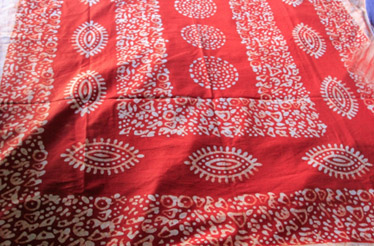
Batik Print uses wax block printing. Craftsmen draw out the perfect wax pattern on fabric with no guidelines, no rough sketches. In one way for printing, the selected area of the fabric is covered with hot wax and the cloth is then dyed. The portions covered with wax resist the dye and stay in the actual colour. The fabric is then washed in hot water to get rid of the wax and what remains is the printed fabric. Repeating this multiple times gives desirable textiles. Designs of these prints include fine motifs of flowers, folios and creepers in symmetry.
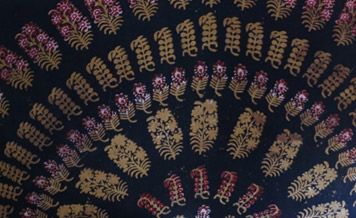
This is one of the few surviving art styles in its pure traditional form. Nandana Prints are a mud-resist style of block printing. The rustic style is captured on chaste cotton with natural dyes. These were worn by the women of the Bhil and Bhilal tribes as their traditional attire. The nomadic life of the Chippa community brought in influences from all over Uttar Pradesh, Madhya Pradesh, Rajasthan, Gujarat and Punjab. The blocks were also sourced mostly from Pethapur, where designs were eclectic. Therefore, the traditional motifs are inspired by nature and have no cultural influence. It mainly involves the four motifs - Mirchi, Champakali, Amba and Jalam buta, derived from plants and flowers. Nandana uses five designs and carved wooden blocks. The craft has 18 steps of printing and dyeing.
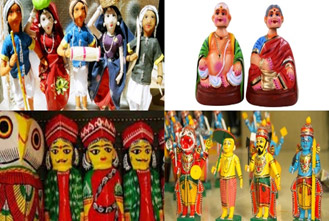
The Batto Bai dolls can be said as a craft, the tribes identify themselves with because the dolls closely resemble the features of various tribes living all across the subcontinent. The expressions and costumes of these traditional dolls are all very traditional, inspired by real-life instances. This craft is named after Batto Bai, a craftswoman from Gwalior. The doll-making process is very sustainable as the craft makes use of recycled scrap cloth. The artisans are generally women who undergo 6 months of training and eventually create a doll.
An interesting fact about the dolls is that they are always sold in pairs because these dolls are considered auspicious for unmarried young girls, who buy a pair each on "Akha Teej" They then get these pairs married at their homes, hoping to be married themselves soon, which they eventually do!
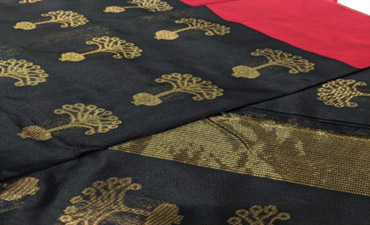
The speciality of Chanderi Weaves lies in the fine-textured fabric of silk and cotton followed by zari woven work, and motifs. The Chanderi sarees are famous around the world and their distinctive features include their floral motifs or ‘Butis’ in the Pallu and their gossamer translucency. The Zari threads in Chanderi sarees are not cut off from underneath the fabric. The motifs have come from traditional coins, geometric prints, peacocks, etc. The Chanderi products are of three types - Pure Silk, Chanderi Cotton and Silk Cotton.
The sarees made using Chanderi Weaves are very light because they are made of single-flature yarn. A popular legend says that a Chanderi cloth was once gifted to the Mughal Emperor Akbar. It was sent across in the narrow hollow of a bamboo stick. When the cloth was drawn out of the bamboo stick, it sent out a shock since it was large enough to cover an elephant.
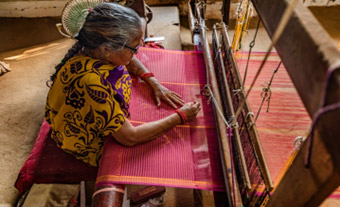
This is a fine handloom cotton & silk yarn woven and brought together with its uniquely bordered traditional five-stripe design running parallel across its length and on its Pallu. The technique used for inserting the border is called Dobby and is used predominantly in Maheshwari weaves. Weavers take inspiration from nature and represent themes like waves of Narmada (leher), rope (rassa), cotton flower (rui phool), etc. in designing borders.
Queen Ahilyabai Holkar, the ruler of Malwa, made Maheshwar her capital city in 1767. This small town by the banks of the river Narmada was transformed during her rule into an active centre of trade and industry. She ordered various craftsmen and artisans from Malwa and Surat to design a special saree with 9 yards, which later came to be known as the Maheshwari Sarees.
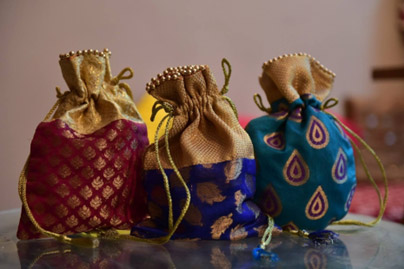
The Batuas or the small purses of Bhopal are famous for their beautiful designs and intricate embroidery work. These purses are popular amongst the local people and are used for storing small coins, betel nuts, scent bottles, cloves, paan and other mouth fresheners. The craft links itself to the early tribal culture, which made beautiful ornaments from wood, shells, metal, ivory and bones. This traditional skill later caught the eye of the Begums (Muslim women rulers) of Bhopal, who supported the craft and gave it a Persian touch. Being the most prominent part of the Nawabi culture in the past, these purses are now used as souvenirs too.
After making initial sketches and planning the motifs, the cloth is given to the tailor who stitches it in the desired shape and does the final fitting.
From a mere photographic reference, the craftsmen and their families, make figurines of animals as they cater to taxidermy enthusiasts. From miniature to life-size, an accurate figurine, complete with posture details and muscular curvature, is skilfully created by the craftsmen with lifelike precision. The leather is stuck and is only worked upon when orders are placed. They are mainly marketed as showpieces, Souvenirs and furniture.
The craft of leather making in Indore was pioneered by Gaffar Khan, who received a National Honor in 1943. He would sculpt deities for festive occasions. Later he came upon the idea of making animals and giving them a realistic look.
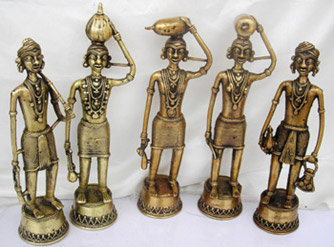
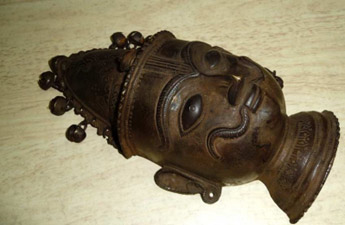
The art of sculpting brass using the ancient technique of lost–wax casting is practised in Madhya Pradesh along with Chattisgarh, Odisha and West Bengal. Dhokra art form has been around for about 4000 years and is regarded as one of the greatest heritages from the Harappa and Mohenjo-Daro civilizations. The dancing girl of Mohenjo-Daro is among the earliest known examples of Dhokra art.
Wax strings are coiled to create beautiful patterns. The natural beeswax retains its malleability even after cooling down, making it an excellent choice for creating coiled shapes and miniature patterns that are a combination of abstract and realism. Tribal myths, magic and designs inspired by nature are given form through this art.
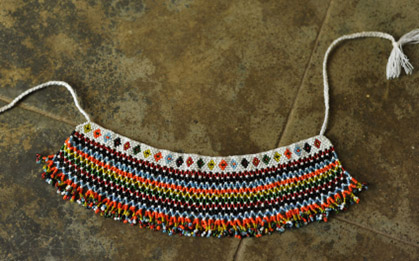
Beadwork is a craft that is practised by many tribes across the world and is an expression of their colourful culture. Jhabua in Madhya Pradesh is famous for its beadwork and the craft is actively practised here. Women in families thread together tiny, colourful beads to create intricate pieces of jewellery with designs inspired by nature. Traditionally the tribes used beads as money, talismans and for decoration purposes but later the beads were used in making ornaments, handbags, table runners and other accessories.

The bell metal casting in Madhya Pradesh's Tikamgarh has been practised for over three centuries. The craftsmanship initially catered to kings and soldiers for war weapons. Today, all kinds of decorative items are crafted here for every need and desire. The process of metal casting used in Tikamgarh is very similar to the Dhokra art as both the crafts take shape with lost wax casting, a common material used to cast objects is metal. But while the Dhokra is created with thin strings of wax, in the bell metal craft of Tikamgarh, the metal pieces are sculpted in the usual way and moulds are created to produce the objects. A mixture of industrial wax, groundnut oil and a binding resin is heated and used as the modelling material. In case of larger articles, a clay base is made, over which this wax mixture is coated and given the final shape.